AI Innovation in Emerging Markets
An emerging market economy refers to the economy of a developing nation that is becoming increasingly integrated into global markets as it grows. These economies are typically in transition, from low-income, less industrialized systems to more modern, industrial economies with rising standards of living. Countries commonly recognized as emerging markets include India, Mexico, Brazil, China, Iran, Saudi Arabia, and Russia.
As a Nigerian, I naturally sought to confirm whether Nigeria fits this classification, and it does. This article by Novatia Consulting classifies Nigeria as an emerging market, citing its significant growth across manufacturing, financial services, technology, and other key sectors.
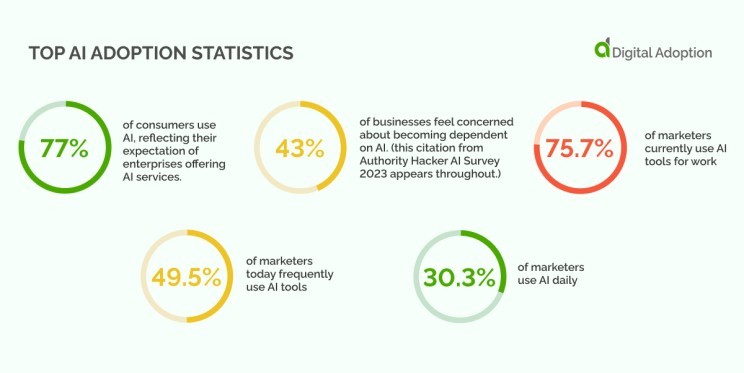
With that context, let us now turn to the state of AI innovation in emerging markets. Artificial intelligence has become a viral, transformative force in the global technology ecosystem. AI is now the most dominant conversation in tech circles globally, and for good reason. According to recent industry reports, 72% of organizations worldwide are currently using AI, up from 50% in previous years. Adoption of generative AI specifically has also surged, now reaching 65%. AI is projected to contribute a staggering $15.7 trillion to the global economy by 2030, while also reshaping labor markets, displacing some jobs and creating new ones.
These statistics, as shared in Tristan Ovington's article "41 Top AI Adoption Statistics for 2024," illustrate just how fast the adoption curve is accelerating.
Trends and Contextual Examples: Health, Agriculture, Education, and Governance
Artificial Intelligence is reshaping how we live, work, and interact with results that are, quite frankly, both mind-blowing and inspiring. This future is already here. From health and agriculture to education, governance, and marketing, AI is redefining what is possible. It has introduced more efficient, scalable, and cost-effective ways of solving problems.
Time and cost savings often lead to greater productivity, which translates into higher income generation, improved services, and economic growth both for individuals and for institutions across public and private sectors.
On the African continent, several innovations demonstrate the real-world application of AI. For example, in healthcare, Ask AwaDoc is an AI-powered health companion that delivers fast, accessible, and affordable medical information through WhatsApp, a platform already widely used across Africa. Solutions like this meet users where they are, making innovation not just high-tech, but high-impact.
Globally, we also see AI reshaping business models. Klarna, a major fintech company, recently reported that its strategic adoption of AI significantly increased operational efficiency. According to TechCrunch, Klarna is now on track to generate $1 million in revenue per employee, up from $575,000 a year ago — driven largely by AI-powered enhancements. The biggest financial shift came from drastically reduced customer service costs.
IBM has similarly embraced AI, not to cut jobs, but to redirect human capacity. While the company used AI to automate some HR roles, the freed-up resources were reinvested in hiring programmers and salespeople — showing how AI can be used to realign workforce strategy rather than merely replace it.
Who Gets Left Behind?
While it's true that AI is becoming increasingly embedded in daily life, it might not be accurate to say that most people are actively using AI or even aware of when they are using it. This was a discussion I got into recently with Toluwani Alade, and it got me reflecting. Many interact with AI-driven systems daily without recognizing it: recommendation engines, chatbots, automated banking services, etc.
However, there remain significant populations at risk of exclusion from the AI revolution due to structural, economic, and social barriers. These include:
- Developing countries with limited infrastructure and insufficient investment in AI R&D
- Lower-skilled workers whose jobs involve routine, automatable tasks
- Older adults who face challenges in adapting to new technologies
- Digitally illiterate individuals who lack the skills to engage with AI tools
- People with limited access to technology, including affordable devices or stable internet
- Ethnic minority groups, where biased data could exacerbate existing inequalities especially in sectors like healthcare or law enforcement
- Small businesses that may struggle with the cost, expertise, or capacity to adopt AI solutions
These gaps reveal an urgent need for intentional, inclusive policy frameworks and market solutions that ensure AI innovation doesn't deepen existing divides but rather helps bridge them.
Why Scaling and Adoption Matter
While the promise of AI is vast and profitable, scaling it equitably remains a major challenge. The innovation-to-impact gap refers to the growing divide between what AI can do and who it truly benefits. Without intentionality, many people and communities will be left behind, limiting both the societal value and long-term viability of AI innovations.
As considered earlier, the benefits of AI are not evenly distributed. Access to AI-powered tools is often constrained by geography, infrastructure, socioeconomic status, and digital literacy. While AI creates new roles — as seen in IBM's strategic workforce reallocation — it simultaneously threatens jobs involving routine and repetitive tasks, particularly in low-skill labor markets.
Bias in training data can also lead to systemic discrimination, especially when diverse communities are not involved in the design, development, or deployment of AI systems. Furthermore, AI's reliance on vast data sets introduces complex issues around privacy, surveillance, and misuse — raising the stakes for responsible governance.
Even with high demand for AI solutions, many emerging markets face a shortage of skilled professionals able to build, implement, and maintain AI systems. Without localized talent and inclusive design, AI risks reinforcing existing inequalities rather than resolving them.
From Scale to Societal Impact, Investment Readiness, and Sustainability
True scale requires more than just market penetration. It demands readiness in infrastructure, investment, policy, and education. Countries that want to harness AI for national development must treat AI readiness with the same urgency once given to digital transformation agendas.
Achieving investment readiness involves building foundational support:
- Access to affordable computing resources and data infrastructure
- Reliable electricity and high-speed internet connectivity
- National funding for AI research and responsible innovation
- Public-private partnerships for workforce development
At the same time, long-term sustainability must be prioritized. This includes building regulatory frameworks that mitigate AI-related risks such as algorithmic bias, data misuse, or exclusionary practices — and embedding ethical principles into AI governance and deployment.
An equitable AI future envisions people becoming AI-literate and irreplaceable, not simply displaced. It means governments delivering faster, more efficient public services; entrepreneurs scaling AI-enabled ventures; and students learning in AI-enhanced classrooms. It also means developing safeguards to prevent misuse: regulatory oversight, audit trails, authentication systems, and culturally representative datasets.
We must scale AI with care and intention. This means not only directing investment into innovation hubs but also ensuring rural communities, underrepresented populations, and low-income groups are not excluded. Bridging AI inequality gaps is not a matter of charity — it's a strategic necessity for inclusive growth.
Responsible scale requires: upskilling citizens for AI-era careers, making AI-powered tools accessible across sectors, designing governance frameworks that protect rights and data, and ensuring AI systems reflect local values, languages, and realities.
The Cost of Scaling AI
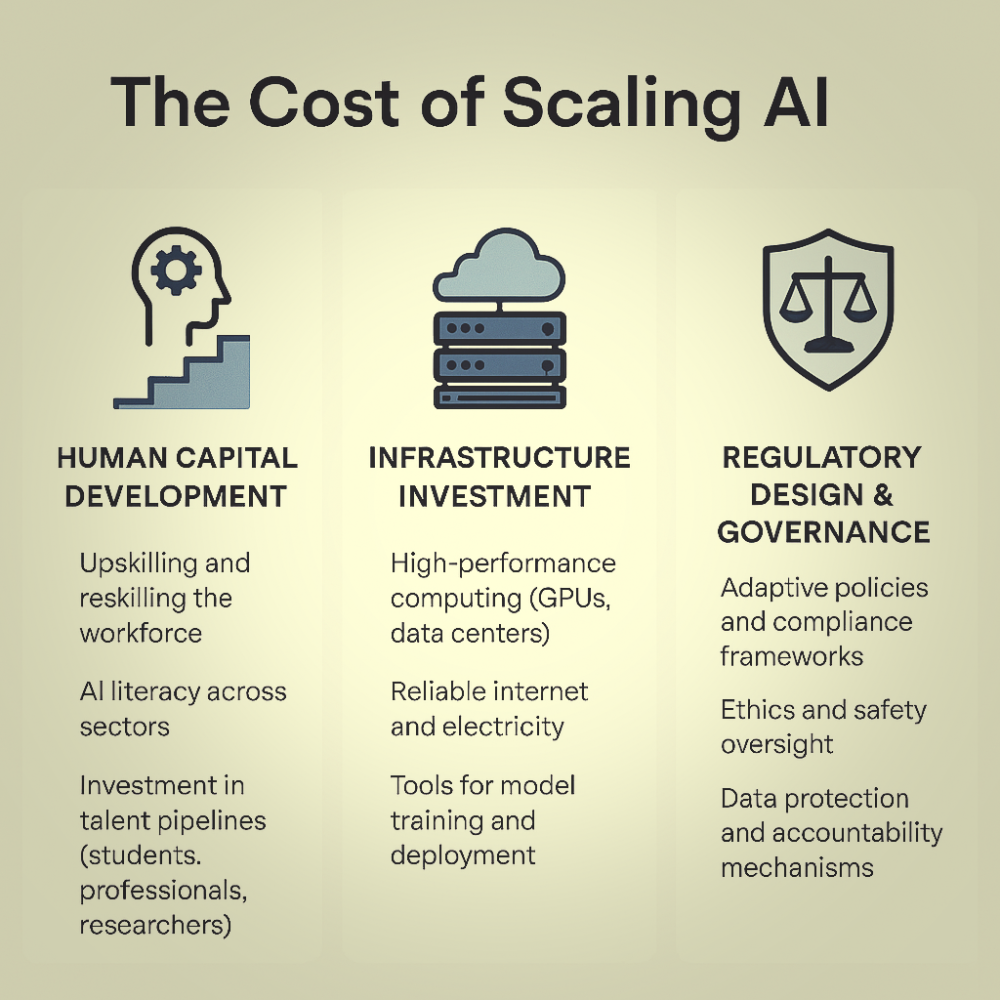
While the urgency to scale AI is clear, the conversation must include the cost of scaling — not only in terms of technology, but across human capital development, infrastructure investment, and regulatory design. Building inclusive, resilient AI systems at scale requires substantial and sustained commitments.
Let's have a look at these three critical dimensions: human capital, infrastructure, and regulatory capacity.
1. Human Capital: The Foundation of an AI-Driven Future
No AI system can function without the people who design, deploy, and manage it. Scaling AI requires countries to make deliberate investments in talent development to avoid displacement and ensure broad-based participation in AI economies.
This includes:
- Mapping the AI supply chain — from data scientists and machine learning engineers to ethics officers and policy advisors.
- Understanding the AI demand chain — how consumers, businesses, and public institutions will interact with current and emerging AI tools.
- Redesigning curricula, training models, and learning ecosystems to equip the next generation with AI fluency.
This effort is far from cheap. It requires free or subsidized training programs, expert-led instruction, state-of-the-art learning infrastructure, and curriculum reform across formal and informal institutions.
Global examples include:
- UK: Over £1.1 billion invested in AI and future tech training.
- United States: Home to 40% of global AI course enrollments.
- China: Over 3 million students trained in AI since 2020.
- Europe: National skilling programs backed by public investment.
African nations are beginning to respond:
- Nigeria's 3MTT Program aims to train 3 million Nigerians in digital and AI-related skills by 2027.
- Microsoft South Africa has committed to skilling 1 million people in AI by 2026.
- Google is investing $5.8 million in AI training across Sub-Saharan Africa.
But the scale and speed of these efforts must accelerate if African nations are to compete globally and shape AI outcomes locally.
2. Infrastructure: Powering the AI Ecosystem
AI is infrastructure-intensive. Its success depends on stable electricity, high-speed connectivity, data storage, computing power, and hardware like GPUs. The physical and digital infrastructure needed to train and deploy AI systems comes with steep costs:
- Data Centers: $10M–$50M for small-scale centers; large-scale centers can exceed $500M.
- GPUs and Hardware: High-performance chips (e.g., Nvidia H100) are expensive and often scarce.
- Cloud Services: Ongoing cloud costs for model training, deployment, and maintenance.
- Real Estate and Cooling: For data centers, real estate, climate control, and backup power all drive up long-term operational costs.
- Edge Devices and Storage: Necessary for real-time applications and distributed AI systems.
According to Fortune Business Insights, the global AI infrastructure market reached $36.59 billion in 2023 and continues to grow rapidly. This underscores the need for cost-effective scaling strategies that: leverage cloud-based models where possible, enable public-private partnerships for infrastructure funding, and prioritize open-source and lightweight AI tools suited for low-resource settings. Without such planning, infrastructure costs can become insurmountable barriers, especially for developing nations.
3. Regulation: Necessary, But Resource-Intensive
AI regulation is essential for safe, inclusive, and trustworthy innovation — but it also comes with costs on both the developer and regulator sides.
For developers:
- Complying with AI product standards and government guidelines can raise engineering and operational costs.
- Startups, in particular, may find it difficult to scale under complex or unclear regulatory expectations.
- The cost of non-compliance (e.g., lawsuits, reputational damage) can be even higher.
For regulators:
- Convening multi-stakeholder processes and expert panels
- Funding AI research and policy labs
- Monitoring algorithmic transparency and audit trails
- Developing culturally relevant and context-specific policy frameworks
All of these require human resources, budgetary allocations, legal capacity, and technical expertise.
Nations cannot afford to scale AI without strategy. Nor can they afford to ignore the costs. Countries that attempt to scale AI without planning for these core components — talent, infrastructure, and regulation — risk either stagnation or harmful deployment.
Instead, each country must: identify its greatest needs and strategic advantages, forecast future AI applications and workforce gaps, direct resources toward high-impact, context-relevant investments, and leverage regional and international partnerships to offset costs.
Barriers to Effective Scale and Adoption
Despite the global enthusiasm for AI, the path to effective scale and adoption is riddled with structural, regulatory, and societal challenges. Many of these barriers tie directly to the three-phase cost considerations: human capital, infrastructure, and regulation. If countries or institutions are unable to adequately meet these foundational needs, scaling AI becomes increasingly difficult — and in some cases, impossible.
1. Financial Constraints
Inability to meet the financial costs of talent development, infrastructure investment, and regulatory preparedness can stall growth from the outset. Without adequate investment in upskilling the workforce, modernizing infrastructure, and navigating evolving compliance frameworks, nations risk falling behind in the global AI race.
2. Restrictive or Ambiguous Policy Environments
Rigid, outdated, or ambiguous policy frameworks can stifle AI innovation. Regulations that are too strict or poorly defined may discourage startups, hinder experimentation, and delay time-to-market. At the same time, failure to develop context-specific and future-facing regulatory systems can undermine trust and hinder widespread adoption.
3. Non-Compliance with Responsible AI Standards
When AI developers fail to comply with safety, ethics, or accountability guidelines, they risk releasing models that are harmful, biased, or unreliable. These failures create negative user experiences, lead to public backlash, and erode trust in AI systems. The result is a reactive regulatory environment, where governments must redirect resources to damage control rather than proactive innovation.
4. Low Investment in AI Talent and Retention
AI cannot scale without a skilled, future-ready workforce. Unfortunately, many economies — especially in the Global South — lack sufficient investment in AI talent development, leading to brain drain and talent shortages. Nations that fail to build and retain an AI-literate workforce will be unable to sustain AI growth, let alone lead it.
5. Infrastructure Deficiencies
Beyond human capital, many regions face a fundamental lack of digital infrastructure needed to support AI ecosystems. Stable electricity, cloud computing access, affordable devices, and high-speed connectivity are prerequisites for any AI-enabled system. Without foundational digital infrastructure, even the most promising AI strategies will fail to take off.
6. Public Awareness and Societal Resistance
Societal response to AI remains mixed, especially among older populations and marginalized communities. Misinformation, fear of job displacement, and lack of clarity about AI's capabilities and limits all contribute to low public acceptance. If adoption is to be equitable and widespread, AI awareness campaigns must be prioritized — explaining not only what AI can do, but how to engage with it responsibly.
7. Lack of Homegrown, Evolving, Contextual Data
AI systems are only as effective as the data they are built on. In many regions, particularly in Africa, access to high-quality, homegrown datasets that reflect local languages, cultures, behaviors, and real-time shifts is limited. Without such data, models risk being inaccurate, biased, or irrelevant. This leaves room for digital exclusion and reduces the practical usefulness of AI tools for local populations.
8. Poor User-Centered Design
Finally, AI tools that are not designed with their end users in mind — especially across diverse demographics — risk alienating entire segments of the population. Solutions must be inclusive, localized, and easy to understand and use. Failing to consider user experience can severely limit adoption, no matter how technically advanced the solution is.
Recommendations for Policymakers, Innovators, and Funders
Understanding the opportunities, costs, and barriers involved in scaling and adopting AI, what practical strategies can ecosystem players implement to drive equitable growth? Below are some key recommendations tailored for policymakers, innovators, and funders.
1. Strategic Public-Private Partnerships
Scaling AI innovation requires intentional collaboration across sectors. No single stakeholder possesses all the resources needed. The private sector often brings technical expertise, talent, infrastructure, and agile processes. The public sector offers market access, regulatory authority, and public financing. With these complementary strengths, both sectors can co-create solutions that are impactful and scalable. Each stakeholder should assess: What do I need to scale or adopt AI in my organization? What can I offer in return? Partnerships grounded in this mutual value exchange can drive ecosystem-wide progress.
2. Leverage the Strengths of Global AI Leaders
Collaborating with established players in the global AI ecosystem — such as OpenAI, Google, or Microsoft — can accelerate adoption without requiring institutions to start from zero. These organizations often provide extensive learning hubs, technical documentation, and open-source tools. Innovators and institutions can tap into these resources to develop local talent, adapt existing models, or co-build tailored solutions. When approached strategically, such alliances offer not just access to infrastructure but also mentorship and long-term collaboration potential.
3. Encourage Customizable AI Product Franchising
Leading AI developers should create pathways for local innovators to adapt existing AI tools to their unique contexts. Open-source frameworks and APIs allow for cost-effective customization and ensure models are more relevant and inclusive. This franchise-style model — where foundational AI products are localized — can reduce duplication, accelerate deployment, and promote innovation from the bottom up.
4. Establish National and Regional Resource Co-Sharing Models
To reduce duplication and address resource disparities, countries and regional blocs should explore resource co-sharing mechanisms. These could include shared data centers, talent exchange programs, cooperative GPU infrastructure, and harmonized regulatory guidelines. Particularly for countries with similar socioeconomic realities, co-creating standards and pooling technical assets can lower barriers to entry and create a more unified, powerful approach to AI development.
In Conclusion
To lead in building an equitable AI future, stakeholders must begin with a clear-eyed assessment of where they stand: the available resources, the key capability gaps, and the real cost of meaningful adoption. From there, it is critical to identify scalable strategies — from investing in local talent and digital infrastructure to forming global and local partnerships. The journey to widespread AI adoption is not linear or one-size-fits-all. However, by combining strategic foresight with shared responsibility, we can co-create a future where AI innovation is inclusive, ethical, and accessible to all.