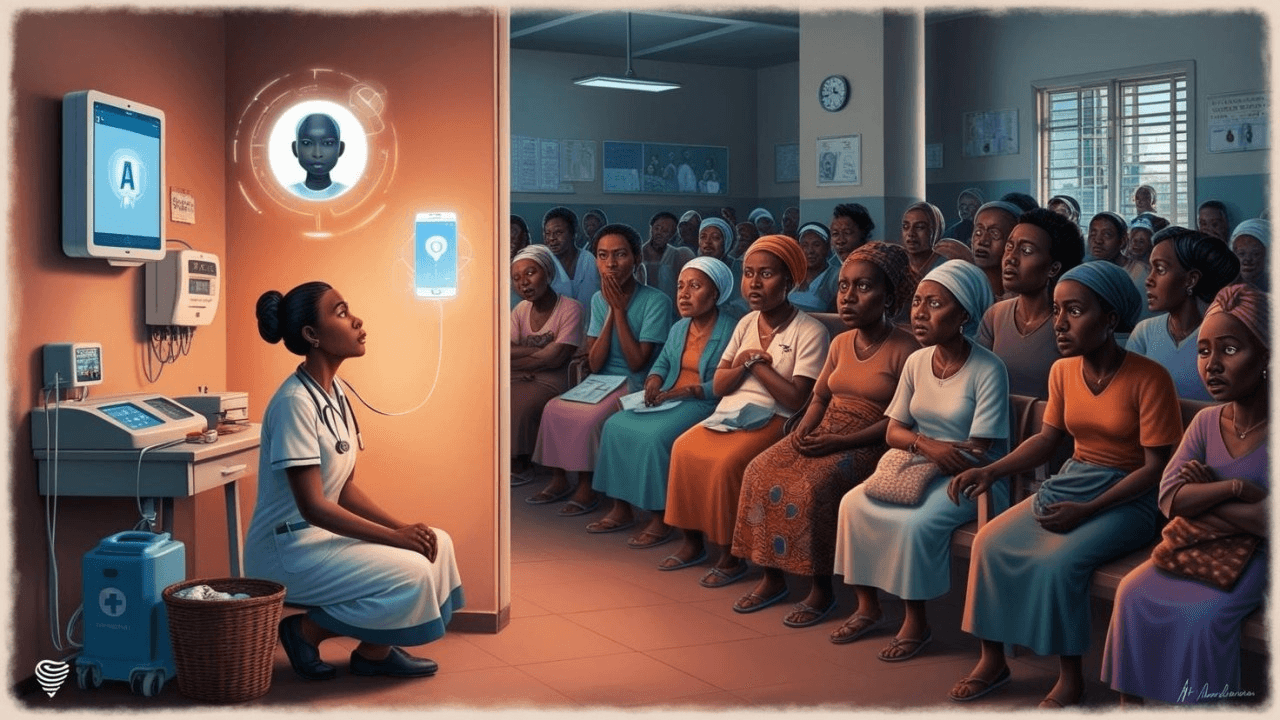
AI in Healthcare: What About the Informal Population?
When we talk about AI in healthcare, the conversation often leans toward advanced diagnostics, robotic surgery, or predictive analytics. But here's a question I keep coming back to: What about the people who still don't even have access to basic healthcare services?
Specifically, I'm talking about the informal population — millions of people working outside formal employment systems. These are street vendors, artisans, market sellers, gig workers, subsistence farmers, the everyday people who make up a massive part of Africa's economy but are largely invisible in healthcare delivery conversations.
A generated definition based on the International Encyclopedia of Human Geography, 2009 elaborates on this by defining the informal sector as a wide range of activities, both legal and illegal, that exist outside the formal economy — characterised by low wages, limited job security, and lack of legal protection.
Why Is Healthcare So Out of Reach for the Informal Sector?
The informal population faces a complex web of barriers that limit their access to healthcare. For many, healthcare services are either unavailable or too far away to reach without significant cost or inconvenience. In some communities, cultural beliefs and traditional healing practices are preferred over modern medicine — sometimes not out of choice, but due to decades of medical neglect and systemic exclusion.
Language barriers further complicate access, especially when healthcare providers do not speak the local dialects or when medical communication tools are designed for urban populations. There's also the issue of documentation. Many individuals in the informal economy lack the official identity papers required to register at hospitals or access government-subsidized care.
Even when services are technically available, affordability is a major hurdle. In healthcare systems that rely heavily on out-of-pocket payments, cost becomes a gatekeeper. And what's most painful is that these communities are often the ones who need consistent, preventive care the most, yet they are often the last in line — if in the line at all.
Take Nigeria, for Example
Despite having one of the largest health workforces in Africa, Nigeria continues to struggle with an acute shortage of frontline healthcare providers, particularly in rural areas. Rural communities, often the heart of the informal sector, are consistently sidelined. Doctors, nurses, and midwives tend to cluster in urban areas, leaving rural populations underserved and vulnerable. This imbalance makes it difficult to deliver appropriate care, especially in regions where the need is most pressing.
The consequences of this gap are far-reaching. Limited access to healthcare among the informal population contributes to increased morbidity and mortality, higher long-term healthcare costs, reduced productivity, and worsening health inequalities. These disparities not only impact individuals and families but also place additional strain on the national healthcare system, further deepening existing socioeconomic divides.
Where Does AI Fit In?
In the revolution of Artificial Intelligence, what role can it play in solving the challenge of inaccessibility of healthcare services, especially for the informal populace? AI presents a wide range of possibilities. The goal is to offer recommendations to stakeholders, builders, inventors, engineers, regulators, and analysts on how to apply these tools to address pressing healthcare challenges — particularly for underserved communities.
1. Promoting the Use of Language Translators in Rural Hospitals
One of the often-overlooked barriers to healthcare access is language. Many rural dwellers speak local dialects that are unfamiliar to healthcare workers deployed from urban areas, and vice versa. Miscommunication can delay treatment, lead to misdiagnosis, or even deter people from seeking care at all.
The use of AI-powered language translators can help bridge this gap. With the right tools, rural patients can describe their symptoms in the language that comes naturally to them, while healthcare professionals receive accurate translations in real time. This improves communication, reduces diagnostic errors, and builds trust between providers and patients.
Importantly, we don't need expensive or complex devices to get started. Mobile-based translation tools already exist and can be introduced through basic training programs for healthcare workers. What's crucial is scaling access and ensuring these technologies are available where they're needed most — starting with our primary healthcare centres.
This still boils down to infrastructure. We must invest in expanding technological reach into rural communities. It's time to move beyond the limiting mindset that rural equals unreachable. In today's world, no one should be left behind because of where they live.
2. The "Go to Them" Model of Service Delivery
There is also an underlying issue of distrust and apathy toward modern healthcare services within many informal communities. Studies show that people often default to traditional methods of treatment, sometimes waiting until an illness has progressed beyond control before seeking formal care.
If the people won't or can't come to healthcare services, then we must bring healthcare to them. There's a common saying: "If the mountain won't come to Mohammed, then Mohammed will go to the mountain." This emphasises the importance of adaptability and taking initiative when direct solutions are not available.
Health ministries and local agencies must commit to regular community health outreach, where health workers go into communities to educate, treat, and build trust. During these visits, there's an opportunity to introduce people to digital tools — some of which may be AI-powered — so that technology is not seen as a foreign or elite solution, but as something designed for them, too.
These community-based approaches can reshape health-seeking behaviours and close the gap between modern healthcare and the people who've historically been excluded from it.
3. AI-Powered Preventive Health Solutions
Artificial Intelligence shouldn't only be used to react to illness — it should help prevent it. That's where its potential becomes even more powerful.
AI systems can be used to predict disease outbreaks before they happen. For example, they can analyse environmental data to forecast malaria outbreaks and trigger automated mosquito spraying or sanitation alerts. AI tools can also monitor hygiene conditions in real time or send early warnings to vulnerable populations during public health crises. They are possible, practical, and cost-effective if implemented with clear intent and community inclusion.
In Conclusion
All of these, including emerging AI innovations, wouldn't be possible without infrastructure. None of these is possible without first addressing the foundational challenges that continue to hinder the adoption of technology in general:
- Unreliable internet connectivity
- Limited electricity supply
- Inadequate technology infrastructure
- Shortage of trained health tech professionals
A recent report by the Global Center on AI Governance titled AI in Africa: A Landscape Study also highlights these barriers in detail, especially as they relate to the African context. The takeaway is clear: no matter how advanced the tools are, they will fail if the systems to support them don't exist.
So, where do we go from here? What other barriers do you see when it comes to delivering quality healthcare to the informal population? What innovations — AI-powered or otherwise — do you think hold real promise?